
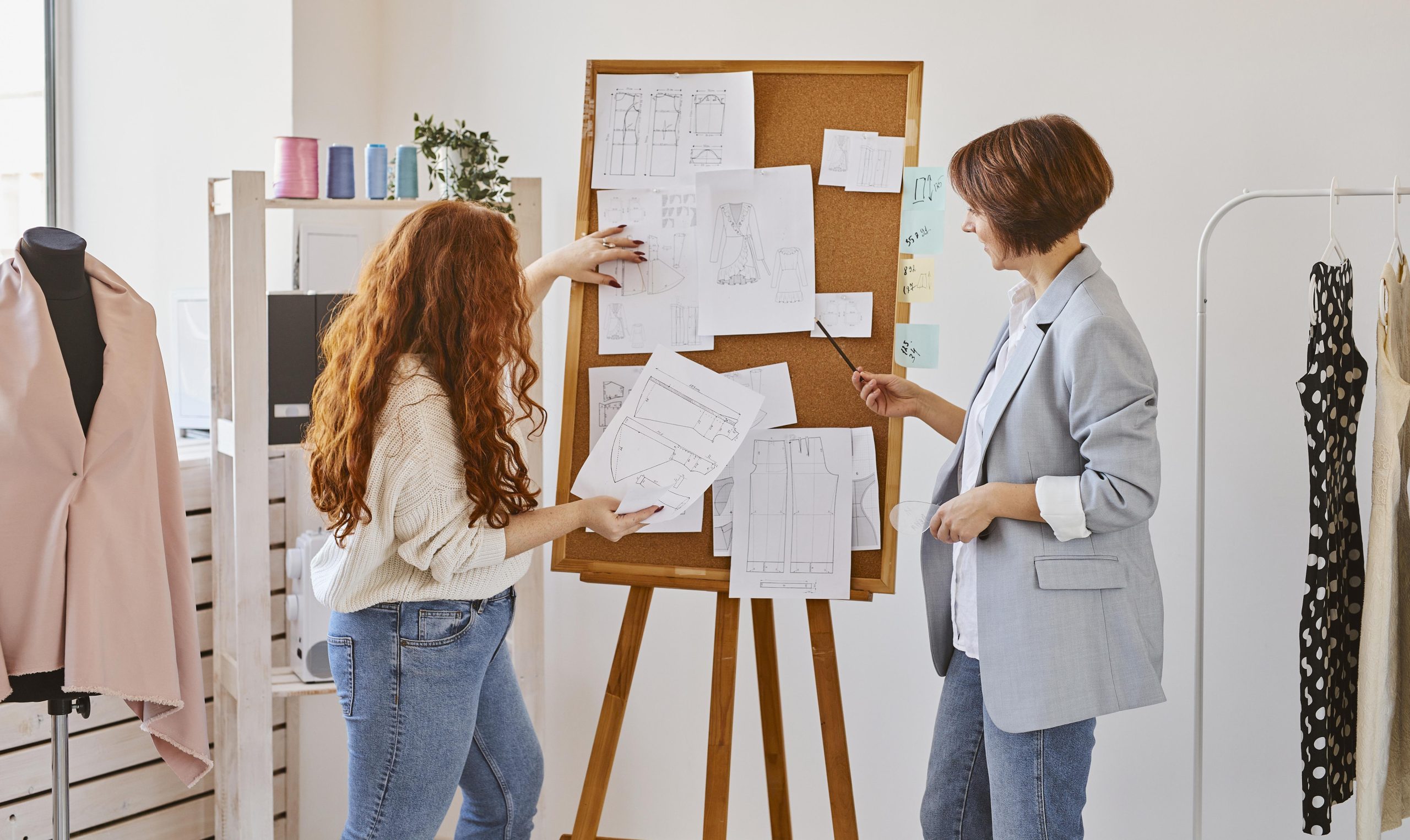
Have you ever looked at a stunning dress in a shop window or a perfectly tailored jacket on a passerby and wondered, “How did that get made?” Or perhaps you find yourself sketching ideas in the margins of your notebooks, dreaming of seeing your own creations worn by others.
The journey of a garment—from a fleeting thought in a designer’s mind to a tangible product hanging in a wardrobe—is a fascinating blend of art, engineering, and business.
Becoming a designer involves determination, passion, and time. While every fashion designer takes a slightly different approach, whether you possess the technical genius of Alexander McQueen or the trend-spotting ability of Miuccia Prada, every garment must start somewhere.
This guide breaks down the fashion design process into actionable steps, demystifying the industry for aspiring creatives and curious minds alike.
For young students exploring their career paths, understanding this process reveals that fashion isn’t just about drawing pretty pictures; it’s about problem-solving, understanding materials, and executing a vision.
It is a discipline that requires the same level of dedication and structured learning found in top-tier educational environments. Let’s explore what it truly takes to bring a piece of clothing to life.
Step 1: The Spark of Inspiration
Every great design begins with an idea. But where does that idea come from? Professional designers rarely wait for a “light bulb moment.” Instead, they actively seek inspiration. This phase is often called “research and development” (R&D).
Creating a Mood Board
The first tangible step is often the creation of a mood board. This is a collage—either physical or digital—that captures the “vibe” of the collection you want to build. It might include:
- Colour palettes: Paint chips, fabric swatches, or photos of nature.
- Textures: Photos of architecture, landscapes, or vintage textiles.
- Historical references: Images from different eras, art movements, or cultural attire.
- Musicians or Icons: People who embody the attitude of the collection.
A mood board acts as your visual anchor. When you get lost in the technical details later, you can look back at the board to ensure your work still aligns with your original vision.
Trend Forecasting
While artistic inspiration is crucial, successful design also requires an awareness of the market. Designers look at trend forecasting reports to see what colours, silhouettes, and materials are predicted to be popular in the coming seasons. This doesn’t mean copying what everyone else is doing; rather, it’s about understanding the current conversation in fashion and deciding how your voice fits into it.
Step 2: Sketching and Illustration
Once the concept is solid, it’s time to put pen to paper. This stage usually happens in two phases: the fashion illustration and the technical sketch (or flat sketch).
The Croquis
Fashion illustration often involves drawing on a “croquis”—a template of a human figure. These drawings are usually artistic and expressive. They focus on the movement of the fabric, the silhouette, and the overall mood of the garment. This is where you experiment with shapes. Will the skirt be A-line or pencil? Will the sleeves be billowy or fitted?
The Technical Flat
While the illustration sells the dream, the technical flat provides the instructions. A “flat” is a black-and-white linear drawing of the garment as if it were laid flat on a table. It shows every seam, button, zipper, and pocket.
This is a critical skill for any aspiring designer. Manufacturers cannot work from an artistic scribble; they need precise diagrams. In a school setting that values holistic growth, learning to draw these technical sketches teaches precision and attention to detail—skills that translate well beyond the art room.
Step 3: Fabric Selection and Sourcing
You can have the most beautiful design in the world, but if you choose the wrong fabric, the garment will fail. Fabric dictates how a piece hangs, moves, and feels on the body.
Understanding Fibre and Weave
Designers must understand the properties of different materials:
- Wovens vs. Knits: Woven fabrics (like denim or shirting) are sturdy and structured. Knits (like t-shirt jersey or sweater material) stretch and drape.
- Natural vs. Synthetic: Cotton, wool, and silk breathe well but can be expensive. Polyesters and nylons are durable and cheaper but may not feel as luxurious.
The Sourcing Process
Sourcing involves finding suppliers who can provide the fabric you need at a price that fits your budget. This often involves visiting trade shows or contacting mills directly. For a student designer, this might mean a trip to a local fabric store, but for a professional, it involves negotiating lead times and minimum order quantities.
Step 4: Pattern Making
This is where the 2D drawing transforms into a 3D shape. A pattern is the template used to cut the fabric. Think of it like a blueprint for a house, but for a shirt or dress.
Draping
Some designers prefer “draping.” This involves pinning fabric directly onto a dress form (mannequin) to create the shape. They manipulate the fabric, folding and pleating it until it looks right, then mark the fabric and transfer those markings to paper. This method is intuitive and hands-on, perfect for those who learn by doing.
Flat Pattern Cutting
Others use flat pattern cutting, which involves using measurements and rulers to draw the shape on paper directly. This is more mathematical and precise. It requires a strong understanding of geometry and human anatomy.
Many boarding schools with strong arts programs emphasise these technical skills because they teach patience and logical thinking. You cannot rush a pattern; if the measurements are off by a fraction of an inch, the pieces won’t fit together.
Step 5: Constructing the Toile (The Prototype)
Before cutting into expensive final fabric, designers make a test version of the garment. In the industry, this is called a “toile” (pronounced ‘twal’) or a muslin.
Why Make a Toile?
- Fit Check: Does the armhole pinch? Is the waist too high? The toile reveals fit issues immediately.
- Design Tweaks: Sometimes, a design looks great on paper but strange in real life. The tool allows you to move a pocket or change a collar shape without wasting money.
- Construction Practice: It allows the sewer to figure out the order of operations. Do you sew the shoulder seams first, or the side seams?
This stage is about refinement. It teaches resilience—a core value in education—because the prototype is rarely perfect. You have to analyse the mistakes, adjust the pattern, and try again.
Step 6: The Sample Making
Once the toile is perfected and the pattern is finalised, it is time to cut the “sample.” This is the first version of the garment made in the actual, final fabric with all the correct trims (buttons, zippers, linings).
The Importance of Finishing
A sample must be sewn impeccably. This includes:
- Seam finishes: Ensuring raw edges are covered so they don’t fray.
- Hemming: Creating a clean edge at the bottom of the garment.
- Pressing: Ironing every seam as you go.
In a professional setting, this sample is what a buyer will look at to decide if they want to stock the item in their store. In a student portfolio, this piece demonstrates their craftsmanship and dedication to quality.
Step 7: Fitting and Grading
The sample is tried on a fit model—a person who represents the “standard” size of the brand (usually a size 6 or 8). The designer looks for any final issues. Does the fabric pull across the hips? Does the hem hang straight?
Grading
Once the sample is approved, the pattern must be “graded.” This means creating versions of the pattern for every other size (XS, S, L, XL). This isn’t just about making it bigger all over; humans grow differently in different areas. Grading is a complex mathematical process that ensures the design looks good on a variety of body types.
Step 8: Production and Manufacturing
If the design is for a single client (bespoke or couture), the process might end with the sample. But for ready-to-wear fashion, the design now moves to production.
The Tech Pack
To communicate with a factory, the designer creates a “Tech Pack.” This is a massive document containing:
The technical flats.
- A bill of materials (list of every button, thread colour, and fabric yardage).
- Measurement charts.
- Construction notes.
The factory uses this guide to mass-produce the garment. Quality control is essential here. Brands will often inspect the “top of production” (the first few items off the line) to ensure they match the sample.
Essential Skills for Aspiring Designers
If you or your child is interested in pursuing fashion design, it helps to nurture specific skills early on. These align closely with the holistic development goals found in structured educational environments.
1. Creativity and Artistic Ability
You need an eye for colour, texture, and shape. Encouraging participation in arts and crafts helps develop this visual language.
2. Technical Sewing Skills
Understanding how things are put together is vital. Even if a designer doesn’t sew the final production pieces, they must know if a design is physically possible to construct.
3. Mathematics and Geometry
Pattern making is geometry in action. Understanding measurements, fractions, and angles is non-negotiable.
4. Communication and Teamwork
Designers rarely work alone. They collaborate with pattern makers, buyers, textile artists, and factories. The ability to communicate a vision clearly and work within a team is a skill often honed through extracurricular activities and group projects in school.
5. Resilience and Discipline
Fashion is fast-paced and competitive. Designs will be rejected; prototypes will fail. Developing a strong character and the discipline to keep going when things get tough is essential for long-term success.
Starting Your Design Journey
You don’t need a professional studio to start designing. Here is how you can begin experimenting at home:
- Modify Existing Clothes: Take an old t-shirt and cut it up. Sew patches onto jeans. This is the easiest way to learn about construction.
- Learn to Hand Sew: Master the running stitch, the back stitch, and the slip stitch. These are the foundations of all sewing.
- Draw Every Day: Carry a sketchbook. Draw what people are wearing. Draw the ideas in your head. It doesn’t have to be perfect; it just has to be consistent.
Study Garments: Look at the inside of your clothes. How are the seams finished? Where is the zipper placed? This is “reverse engineering” and is a great way to learn.
The Future of Fashion Design
The industry is changing. Technology and sustainability are becoming massive factors.
- 3D Design Software: Programs like CLO3D allow designers to create virtual garments without using any fabric, reducing waste and speeding up the process.
- Sustainable Practices: Future designers need to think about the life cycle of their products. What happens to the garment when it is worn out? Can it be recycled?
Schools that offer a future-ready education are increasingly incorporating these concepts into their curriculum, preparing students not just for the jobs of today but for the responsibilities of tomorrow.
Empowering the Next Generation of Creatives
Fashion design is a rigorous, multifaceted discipline that combines art, math, and business. It requires a safe and inspiring environment to flourish—one where mistakes are seen as learning opportunities and creativity is nurtured alongside discipline.
Whether a student dreams of high fashion runways or simply wants to express themselves through their clothing, the skills learned in the design process—planning, execution, problem-solving, and resilience—are transferable to any career path. By providing a holistic learning environment that balances academic rigour with creative exploration, we can empower the next generation to turn their sketches into reality.
Frequently Asked Questions
Do I need to be good at drawing to be a fashion designer?
While drawing helps communicate your ideas, it is not the only way. Many successful designers use computer-aided design (CAD) software or drape fabric directly on a mannequin to express their vision. The key is being able to communicate your idea clearly, regardless of the medium.
What is the difference between a fashion designer and a pattern maker?
A fashion designer conceives the look, mood, and overall aesthetic of the garment. A pattern maker is the architect who creates the technical blueprints (patterns) to make that design physically possible. Both roles are crucial, and many professionals have skills in both areas.
How long does it take to make a piece of clothing?
It varies wildly. A simple t-shirt can be designed and prototypes in a day. A complex evening gown with hand-beading could take hundreds of hours. In a commercial setting, the timeline from initial sketch to store delivery is usually around 6 months.
Is sewing a necessary skill for designers?
Yes, understanding construction is vital. You don’t need to be the fastest sewer in the world, but you must understand how a garment is put together to design effectively. If you don’t know how seams work, you might design something impossible to manufacture.
Turn Your Passion into a Future
The journey from a sketch to a finished garment is long, but incredibly rewarding. It mirrors the journey of education itself—starting with potential, applying discipline and structure, and emerging with a tangible result.
If you are looking for an environment that nurtures this kind of potential—where academics, arts, and character building go hand in hand—consider how a structured, residential school experience can shape a child’s future.
