
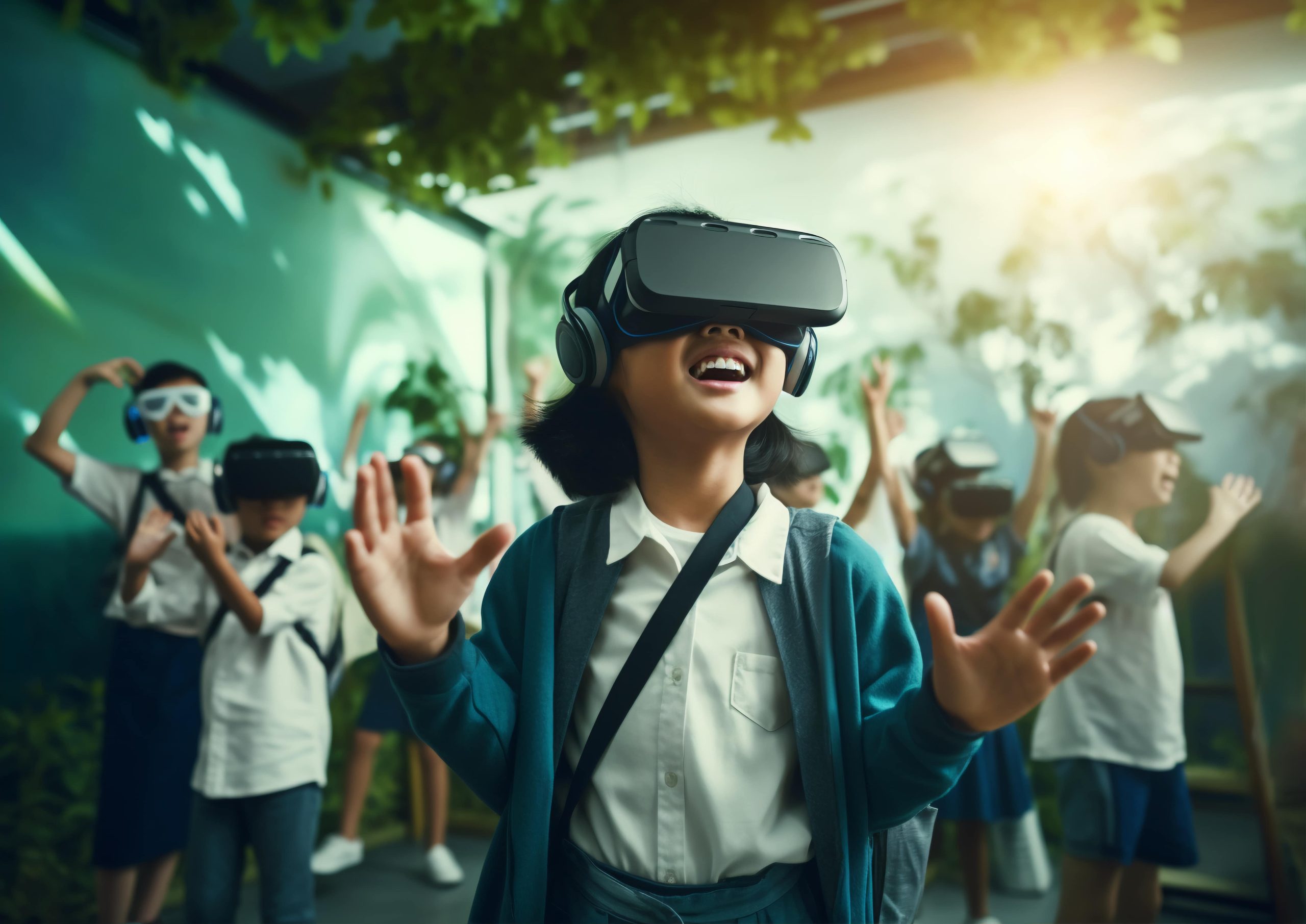
Remember the days of rote memorization? We sat in rows, staring at flat images in a textbook, trying to visualize how a strand of DNA spirals or how the Roman Colosseum looked in its prime. For many of us, school was a test of endurance rather than an adventure.
But for your child, the script is flipping. Education is undergoing a seismic shift. It is moving away from passive listening and toward active, immersive participation. Leading this charge are Augmented Reality (AR) and Virtual Reality (VR).
These aren’t just buzzwords or gaming toys anymore. They are powerful educational tools that are reshaping how schools nurture potential and foster holistic growth. For parents concerned about their child’s engagement or ability to grasp complex subjects, these technologies offer a bridge between abstract concepts and real-world understanding.Here is why immersive technology is becoming a cornerstone of future-ready education and what it means for your child’s learning journey.
What is the difference between Augmented Reality and Virtual Reality?
Before understanding the benefits, it helps to distinguish between the two technologies, as they serve different roles in a holistic learning environment.
Augmented Reality (AR) enhances and modifies your surroundings rather than replacing them. It integrates digitally created elements—like animations, 3D models, or text—into a live view of the real world. This is usually done through a smart device’s camera, such as a tablet or smartphone.
Think of it as a digital layer over the physical world. AR makes digital information accessible instantly without disrupting the user’s environment. For a student, this might look like pointing a tablet at a diagram of a frog in a biology textbook, only to watch the anatomy pop up in 3D on the screen, allowing them to examine the organs from different angles.
Virtual Reality (VR), on the other hand, is total immersion. It shuts out the physical world completely using a headset, transporting the user to a computer-generated environment. In a VR setting, your child isn’t just looking at a picture of Mars; they are standing on the surface of the planet, looking around, and exploring the terrain.
How does immersive technology improve academic performance?
One of the biggest challenges in traditional education is the “disconnect.” Students often struggle to see how lines on a graph or dates in a history book apply to real life. This lack of connection leads to a lack of focus—a common trigger for parents seeking a more structured environment like a boarding school.
Immersive technology solves this by turning abstract concepts into tangible experiences.
Visualizing the Invisible
Complex subjects like molecular biology, physics, and chemistry deal with things we cannot see with the naked eye. VR and AR allow students to shrink down to the size of an atom. They can manipulate chemical bonds with their hands or watch the flow of electricity through a circuit.
When learning becomes hands-on and interactive, retention rates soar. Students aren’t just memorizing facts for an exam; they are building a deep, intuitive understanding of how the world works.
Time Travel in History Class
History often feels dry when it is reduced to names and dates. VR changes the narrative by acting as a time machine. Students can “visit” the trenches of World War I, walk through the halls of Versailles during the signing of the treaty, or witness the construction of the Great Wall of China.
This fosters emotional intelligence and empathy—key components of character building. It is one thing to read about a historical event; it is another to stand in the shoes of the people who lived through it.
Why is a structured environment best for this technology?
You might be thinking, “Can’t my child just do this on a VR headset at home?” While home technology is advancing, the true educational power of AR and VR is unlocked in a structured, nurturing environment like a residential school.
Guided Exploration
Technology is a tool, not a teacher. In a dedicated learning environment, expert educators guide the experience. They ensure that the VR session isn’t just “cool,” but that it aligns with curriculum goals. A teacher can pause a simulation to ask critical thinking questions, ensuring the student is processing what they see.
Collaborative Learning
A common misconception is that VR isolates children. However, in a forward-thinking school setting, it encourages teamwork. One student might be the “explorer” inside the headset, while their classmates guide them using data on tablets. This mimics real-world scenarios—like a mission control team guiding an astronaut—teaching vital communication and leadership skills.
Safety and Balance
Parents often worry about screen time. In a boarding school setting, technology use is disciplined and intentional. It is balanced with robust extracurriculars, sports, and face-to-face social interaction. The technology is used to enhance learning, not to escape reality.
How does VR make dangerous learning environments safe?
Safety is a top priority for any parent. Some of the most valuable educational experiences are inherently risky or expensive to replicate in a standard classroom. VR eliminates these barriers.
The Virtual Science Lab
In a traditional chemistry lab, mixing the wrong chemicals can be dangerous. In a VR lab, students can conduct volatile experiments, make mistakes, and witness the chemical reactions without any risk of injury. This allows for a “fail-safe” environment where students are encouraged to experiment and learn from their errors—a crucial part of building resilience.
Medical and Technical Training
For older students interested in medicine or engineering, VR offers training that was previously reserved for professionals. They can perform virtual surgeries or disassemble a jet engine. This level of exposure helps students clarify their career aspirations early, giving them a head start on their future.
What soft skills do AR and VR develop?
We know that academic excellence is only one part of the equation. To succeed in the modern workforce, children need soft skills. Immersive tech is surprisingly effective at teaching these.
- Empathy and Perspective: VR documentaries can place students in the lives of refugees or people from different cultures, fostering a global perspective and compassion.
- Public Speaking: Speaking in front of a crowd is a common fear. VR simulators can generate a virtual audience, allowing students to practice their speeches and presentations in a low-stakes environment before stepping onto a real stage.
- Problem Solving: Many educational AR/VR applications are gamified, requiring students to solve puzzles or complete missions to progress. This strengthens critical thinking and logic.
Why is tech literacy essential for your child’s future?
We are preparing students for jobs that don’t even exist yet. However, we do know that the future will be digital. Industries ranging from architecture and real estate to healthcare and manufacturing are already adopting AR and VR workflows.
By integrating these tools into their daily education, students become fluent in the technology of the future. They stop being just consumers of technology and start becoming creators and power users. This gives them a significant competitive advantage when applying to universities and entering the job market.
How does this align with holistic growth?
At Doon Edu, we believe that education must be holistic. It’s not just about the grades; it’s about the person your child becomes. Immersive technology is a powerful ally in this mission.
It sparks curiosity in the “dreamer” within your child. It engages the athlete who learns better by moving than by sitting still. It empowers the quiet student to find their voice in a virtual setting.
When combined with small class sizes, mentorship, and a wide range of sports and arts, AR and VR help create a truly future-ready learning ecosystem. It transforms the classroom from a room of requirement into a world of opportunity.
Taking the next step
If you feel your child is drifting in a crowded classroom, or if you want to ensure they are prepared for a tech-driven future, consider an environment that embraces innovation.
Education is the most significant investment you will make in your child’s life. Ensure it is an investment that speaks their language and prepares them for their world, not the world of the past.
We invite you to explore how we blend tradition with innovation to nurture the leaders of tomorrow.
