
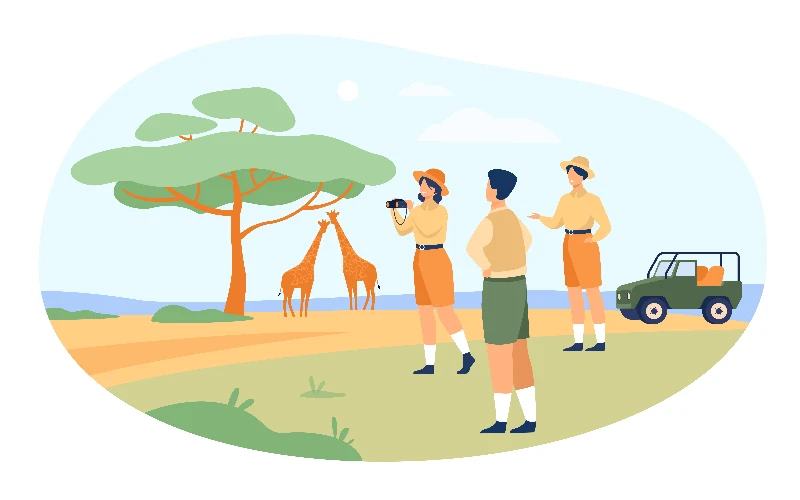
There is a moment on every safari that stays with you forever. It might be the sudden silence that falls over the jeep when a leopard steps out from the tall grass. It could be the deep, vibrating rumble of an elephant herd communicating miles away, or simply the vast, unpolluted blanket of stars covering the savanna at night.
Wildlife tourism offers something that no documentary or zoo visit can replicate: an unfiltered, raw connection with the natural world. It places you in the middle of an ecosystem where humans are observers, not masters. For many, a safari is a bucket-list item, a once-in-a-lifetime journey to see the “Big Five”—lion, leopard, rhinoceros, elephant, and Cape buffalo. But the experience extends far beyond checking animals off a list.
This form of travel has evolved significantly over the last few decades. It is no longer just about sightseeing; it is about conservation, community support, and understanding the delicate balance of our planet’s biodiversity. Whether you are planning your first game drive or looking to explore new frontiers in wildlife travel, understanding where to go, how to prepare, and the impact of your footprint is essential.
The World’s Most Spectacular Safari Destinations
When people hear the word “safari,” their minds usually jump to the sweeping plains of East Africa. While that is the classic experience, wildlife tourism encompasses diverse ecosystems across the globe. Here are some of the premier destinations for witnessing nature at its finest.
The Giants of East Africa
East Africa remains the heartland of the traditional safari. Tanzania’s Serengeti National Park and Kenya’s Masai Mara are famous for the Great Migration, where millions of wildebeest and zebra traverse the plains in a perilous loop, followed closely by predators. The sheer density of animals here is unmatched. For those seeking a backdrop of snow-capped peaks, Amboseli National Park in Kenya offers iconic views of elephants against Mount Kilimanjaro.
Southern Africa’s Diverse Landscapes
Southern Africa offers a different, often more private experience. South Africa’s Kruger National Park is accessible and vast, offering excellent infrastructure for self-drive safaris. For a more aquatic adventure, Botswana’s Okavango Delta provides a unique perspective. Here, you travel by mokoro (dugout canoe), gliding silently past hippos and crocodiles in a lush water wilderness. Namibia offers a stark contrast with its desert-adapted wildlife, where you can track rhinos across arid, moon-like landscapes.
Beyond the African Continent
Wildlife tourism isn’t limited to Africa. India’s Ranthambore National Park is one of the best places in the world to see wild tigers in their natural jungle habitat. In South America, the Galapagos Islands in Ecuador offer an evolutionary showcase where animals have no instinctive fear of humans, allowing for unparalleled close encounters with marine iguanas, giant tortoises, and blue-footed boobies.
Preparing for the Bush: What to Pack and Expect
A safari is not your average vacation, and preparation is the key to enjoying the experience comfortably. The environment can be harsh, the days are long, and the logistics are specific.
The Art of Packing
Leave the bright colors at home. Neutral tones like khaki, olive, and brown are essential, not just for the aesthetic, but to blend into the bush and avoid attracting tsetse flies (which are drawn to dark blue and black).
Layering is your best strategy. Game drives often start before dawn when temperatures can be near freezing, only to soar into the 80s or 90s by midday. You will want a warm fleece that you can shed as the sun climbs.
Regarding gear, a good pair of binoculars is non-negotiable. While the guide will have a pair, having your own ensures you don’t miss a fleeting cheetah hunt while waiting your turn. Similarly, bring a camera with a decent zoom lens; smartphone cameras often struggle to capture wildlife at a distance.
Managing Expectations
The most important thing to pack is patience. Wildlife is unpredictable. You might drive for three hours and see nothing but impalas, or you might turn a corner and find a pride of lions eating a kill. Trust your guide’s instincts and enjoy the small things—the dung beetles, the colorful rollers, and the botany—while you wait for the big game.
Health is another major consideration. Many prime safari destinations are in malaria zones. Consult a travel doctor months in advance to sort out necessary vaccinations and prophylactic medication.
The Ethics of Wildlife Tourism
As the popularity of wildlife tourism grows, so does the responsibility of the traveler. Not all animal encounters are created equal, and some “sanctuaries” or tours can be detrimental to the animals they claim to protect.
Ethical Interactions
The golden rule of responsible wildlife tourism is observation without interaction. Avoid any attraction that allows you to touch, pet, walk with, or ride wild animals. If a lion cub is being passed around for photos, it has likely been taken from its mother and sedated. Similarly, riding elephants often involves cruel training methods. True sanctuaries do not treat wild animals as pets or props.
Choosing the Right Operator
Do your research on lodges and tour operators. Look for companies that prioritize conservation and have a clear sustainability policy. Eco-friendly lodges should be minimizing their carbon footprint through solar power, waste management, and water conservation. They should also be transparent about how they minimize the disturbance to animals during game drives, such as adhering to strict rules about off-roading and maintaining distance.
Conservation and Community: The Power of Your Dollar
When done correctly, safari tourism is one of the most effective tools for conservation in the world. The economic mechanics are simple: if an animal is worth more alive than dead, it will be protected.
Funding the Frontlines
Park fees and conservation levies included in your ticket price go directly toward funding the management of protected areas. This money pays for park rangers, anti-poaching units, veterinary care for injured wildlife, and the maintenance of fences and roads. Without tourism revenue, many of these parks would lack the resources to defend against poachers or habitat encroachment.
Empowering Local Communities
The most successful conservation models involve the people living on the borders of the parks. Sustainable tourism provides employment—from guides and trackers to lodge staff and suppliers. When local communities see tangible economic benefits from wildlife, they become its staunchest protectors.
Community-owned conservancies in places like Namibia and Kenya have shown that when land is managed for wildlife tourism rather than farming, biodiversity recovers, and community wealth increases. By choosing to travel, you are investing in the survival of these ecosystems.
Why the Wild Matters
Visiting these wild spaces changes you. It offers a perspective shift that is hard to find in modern city life—a reminder that we are part of a much larger, complex, and beautiful system. The allure of the safari is not just in seeing a lion; it is in understanding the lion’s place in the world, and by extension, our own.
By choosing responsible operators, respecting the wildlife, and traveling with an open mind, you become an active participant in the preservation of our planet’s most precious resources. The roar of the wild is fading in many places, but through conscious tourism, we can help ensure it echoes for generations to come.
