
We often watch virtuoso musicians—whether a concert pianist or a lead guitarist—and assume they were born with a divine gift. We see the result, but we rarely see the hours of repetition, the frustration of missed notes, and the discipline required to master the craft.
For parents, watching a child struggle with a new instrument can be disheartening. You want them to experience the joy of music, but the initial learning curve often feels like a steep mountain to climb.
Many students give up within the first few months because they don’t see immediate progress. They feel stuck. However, the ability to learn a musical instrument quickly isn’t just about talent; it is about strategy. It is about how you practice, not just how much you practice.
This guide breaks down proven techniques for how to learn an instrument quickly. These strategies are designed to help students navigate the early hurdles of musical education and build a skill that will empower their growth for a lifetime.
The Foundation: Why “Holistic” Matters in Music
Before diving into the mechanics of scales and chords, it is vital to understand why we encourage musical education in the first place. Learning an instrument is one of the few activities that engages the entire brain. It stimulates the areas responsible for vision, hearing, movement, and memory simultaneously.
For a student aged 11-18, whose brain is in a critical stage of development, music is a superpower. It enhances pattern recognition, which translates to better performance in mathematics and science. It improves language skills and increases IQ. But beyond academics, it builds character.
To learn an instrument fast, a student must embrace a holistic approach. This means they aren’t just training their fingers; they are training their ears, their focus, and their emotional resilience. When a child understands that music is a discipline similar to sports or academics, they approach it with a more serious, growth-oriented mindset.
Strategy 1: The Art of Deliberate Practice
The biggest myth in musical education is that practice makes perfect. In reality, practice makes permanent. If your child spends an hour mindlessly playing the same mistakes over and over, they are simply cementing those mistakes into their muscle memory. To learn fast, one must engage in “deliberate practice.”
Quality Over Quantity
It is better to practice for 20 minutes with intense focus than for two hours while distracted by a smartphone or television. In a boarding school environment, we emphasise structured schedules because they allow for these blocks of deep work.
Encourage your child to set a timer. During this time, the goal is not to “play music” but to solve problems. If there is a difficult passage in a song, they should not play the whole song. They should isolate those four bars and work on them until they are fluid.
The Slow-Motion Technique
Speed is a byproduct of accuracy. When a student tries to play fast immediately, they develop tension and sloppy technique. The fastest way to learn is, ironically, to slow down.
Using a metronome is non-negotiable. Have your child set the tempo to a painfully slow speed—one where they can play the piece perfectly without thinking. Once they can play it three times in a row without error, increase the speed by just 5 beats per minute. This incremental increase tricks the brain. It builds the neural pathways required for speed without the student realising they are playing faster.
Strategy 2: “Chunking” the Curriculum
Cognitive science tells us that the human brain learns best when information is broken down into small, digestible bites. This concept, known as “chunking,” is essential for rapid musical progress.
When a student looks at a complex page of sheet music, they often feel overwhelmed. The sheer volume of notes causes anxiety, which hinders learning. Instead, teach them to treat the piece of music like a puzzle.
Breaking It Down
- The Macro View: Listen to the piece in its entirety. Internalise the melody and the rhythm.
- The Micro View: Break the piece into sections—Intro, Verse, Chorus.
- The Nano View: Break those sections into individual measures or phrases.
A student should not move on to the second phase until the first phase is mastered. This creates a sense of constant achievement. Every 15 minutes, they can say, “I have conquered this measure.” This dopamine hit keeps them motivated and engaged, preventing the burnout that often leads to quitting.
Strategy 3: Mental Practice and Visualisation
This might sound counter-intuitive, but some of the most effective practice happens away from the instrument. Professional athletes use visualisation to rehearse plays, and musicians can do the same.
Mental practice activates the same brain regions as physical practice. If your child is away from their instrument—perhaps travelling or resting—they can visualise themselves playing the music. They should imagine the feeling of the keys or strings, hear the pitch in their head, and see their fingers moving to the correct positions.
This technique strengthens the connection between the auditory and motor centres of the brain. When they return to the instrument, they will often find that they can play the piece more fluently than before. It is a powerful tool for accelerating learning without physical fatigue.
Choosing the Right Instrument for Rapid Success
Sometimes, the speed of learning depends on the vehicle you choose. While every instrument has its challenges, understanding the learning curve of each can help manage expectations.
The Piano
- The Learning Curve: The piano offers immediate gratification. You press a key, and it makes a pleasant sound. It is excellent for visualising music theory because all the notes are laid out linearly.
- Fast-Track Tip: Focus on learning chords first. By learning four basic chords (C, G, Am, F), a student can play hundreds of pop songs within weeks. This early success fuels the desire to learn more complex theory.
The Guitar
- The Learning Curve: The first month is physically painful. Building calluses on the fingertips is a rite of passage.
- Fast-Track Tip: Don’t start with complex barre chords. Start with “open chords.” Also, encourage your child to learn to read tablature (a simplified notation system) alongside standard notation. This allows them to start playing recognisable riffs immediately.
The Violin
- The Learning Curve: This is one of the steepest curves. Because there are no frets (markers) on the neck, finding the correct pitch relies entirely on the ear and muscle memory. It can sound “squeaky” for a long time.
- Fast-Track Tip: Focus heavily on posture and bow hold before worrying about the left hand. If the bow arm is stiff, the sound will never be good. Short, frequent sessions are better than long ones to avoid physical strain.
The Drums
- The Learning Curve: Drums are physically demanding and require limb independence (doing different things with hands and feet).
- Fast-Track Tip: Practice without a drum kit. Using hands on knees to tap out rhythms (rudiments) builds coordination anywhere, anytime. Mastering the “para-diddle” is the key to unlocking speed around the kit.
Overcoming the Inevitable Plateau
Every student, no matter how talented, hits a wall. Progress slows down, and the instrument feels like a burden. This is usually where parents panic, fearing their investment was a waste. However, the plateau is actually a sign of growth. It means the brain is consolidating information.
The Role of Routine
This is where a structured environment becomes invaluable. In a setting where discipline is part of the daily fabric, practising isn’t a choice made on a whim; it is part of the routine. When motivation fades, discipline takes over.
Please encourage your child to record themselves. A recording never lies. Listening back to a recording from two weeks ago compared to today is often the best way to see progress that feels invisible day-to-day. It provides objective proof that their hard work is paying off.
The Value of Mentorship and Environment
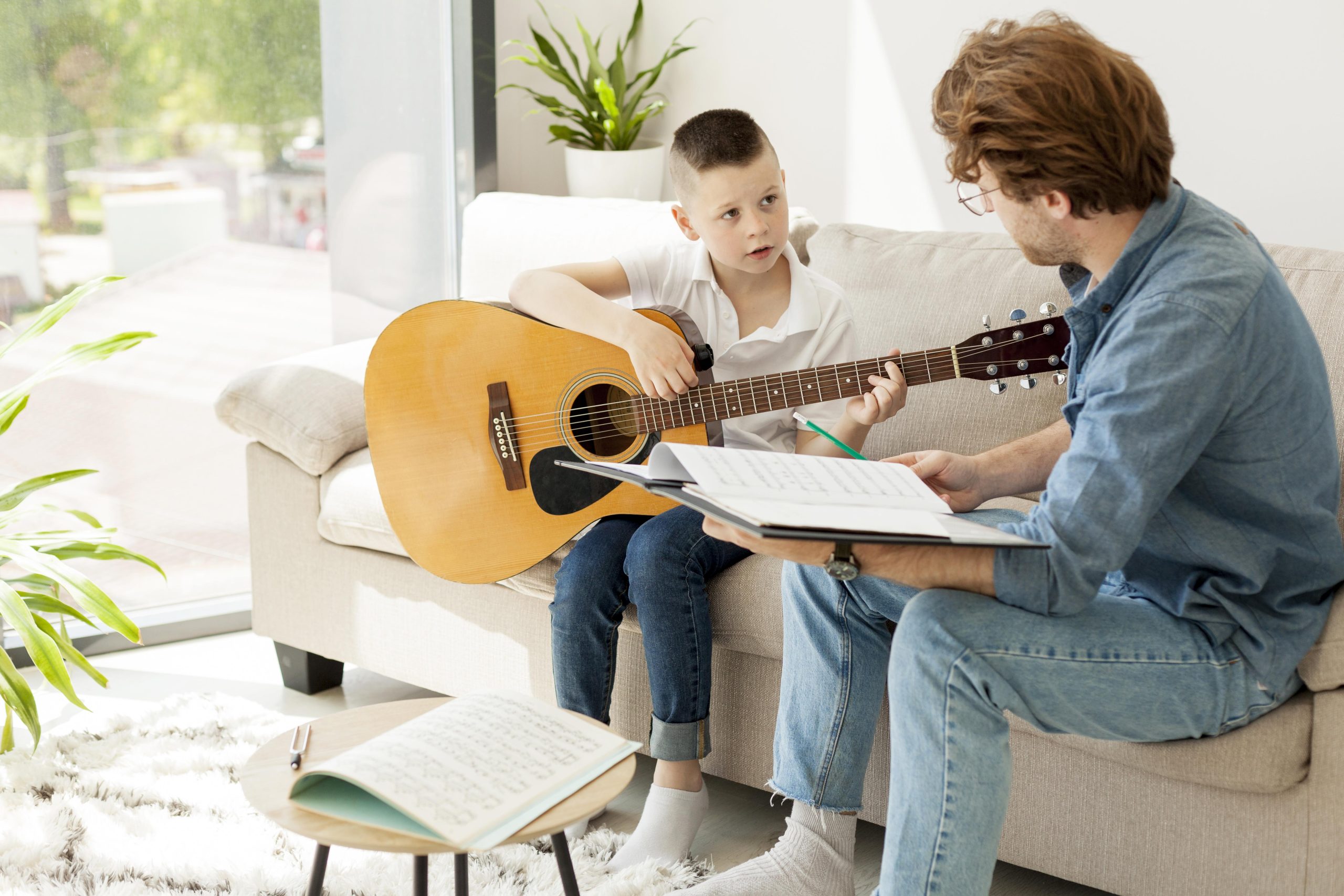
While YouTube tutorials are a fantastic resource, they cannot replace a mentor. A video cannot see that your wrist is at the wrong angle or hear that your rhythm is slightly rushing. To learn fast, you need immediate feedback loops.
A qualified teacher can diagnose a technical issue in seconds that might take a self-taught student months to figure out. Furthermore, learning in an environment surrounded by peers—like a school band or orchestra—accelerates growth. It introduces positive peer pressure. When a student sees their friend mastering a scale, it ignites a competitive spirit and a desire to keep up.
Empowering Your Child Through Music
Learning a musical instrument is a journey that offers rewards far beyond the applause at a recital. It teaches a child that if they break a big problem down into small parts, apply focus, and persist through difficulty, they can master anything. This is the essence of a holistic, future-ready education.
By setting up the right environment, focusing on deliberate practice, and understanding the mechanics of learning, your child can pick up an instrument faster than you might think possible. It requires patience from the parent and discipline from the student, but the result—a confident, creative, and resilient young adult—is worth every note.
If you are looking for an environment that nurtures this kind of potential and balances academic rigour with creative expression, we are here to help guide the way.
